
KAWASAKI, Japan, Dec 1, 2025 - (JCN Newswire) - Fujitsu today announced the successful development of a technology for molecular dynamics (MD) simulation that enables atomic-level structural analysis of the solid electrolyte interphase (SEI) [1] formation process in all-solid-state batteries. This process, previously difficult to analyze, significantly impacts battery performance. Fujitsu achieved this breakthrough by developing a neural network potential (NNP) [2] training method using knowledge distillation [3], enabling stable, long-duration MD simulations. The newly developed technology can now rapidly and accurately reproduce the behavior of all-solid-state battery electrolyte membrane and electrode interface structures [4] with over 100,000 atoms for 10 nanoseconds, requiring only one week of computation.
The innovative nature of this technology has been recognized with the Electric Science and Technology Promotion Award for 2025 from The Promotion Foundation of Electrical Science and Engineering, which was awarded on November 25, 2025.
By linking these technologies, Fujitsu aims to establish a new materials development workflow that accelerates materials development through AI and create new materials together with its customers.
Fujitsu will add this technology into its materials chemistry calculation platform SCIGRESS and begin providing it to customers by March 2026.
Overview
Fujitsu developed a knowledge distillation technique (Figure 1) to precisely train NNPs with a faster multi-layer perceptron (MLP) [7] architecture. This is achieved by transferring knowledge from computationally slower, but knowledge-rich, GNN-based published NNPs. This approach allows MLP-based NNPs to leverage extensive published NNP knowledge and specialized material structure insights, enabling stable, high-speed, long-duration MD simulations for large-scale systems exceeding 100,000 atoms.
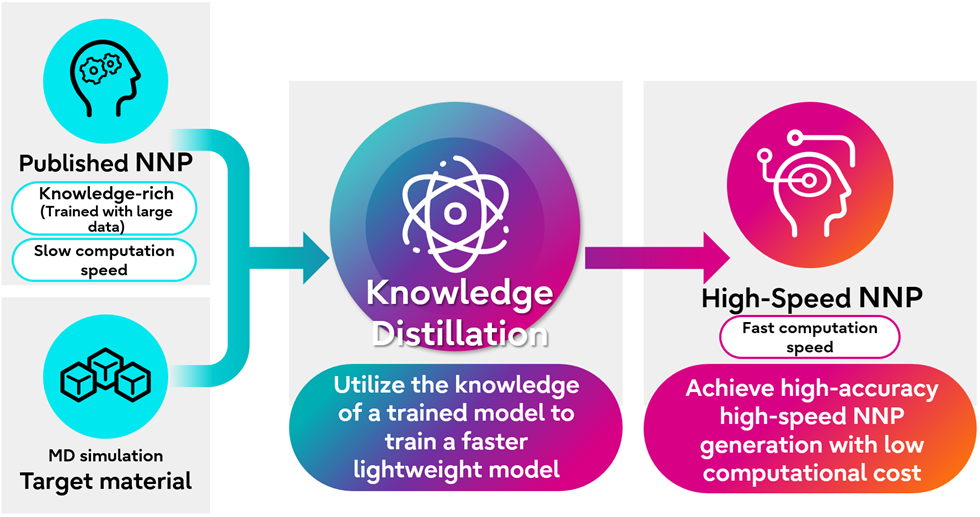
Figure 1: Outline of the new technology
Results
When applied to a next-generation all-solid-state battery interface (127,296 atoms), Fujitsu confirmed stable, 10-nanosecond MD simulations in approximately one week (Figure 2(b)). This enabled structural analysis of the SEI, critical for battery performance and previously unachievable with existing MD simulations. SEI defines the charge-discharge cycle life and safety of all-solid-state batteries, and understanding its atomic-level formation and stability is crucial. This technology is expected to accelerate the development of a method to control SEI formation by elucidating its previously unknown atomic-level processes.
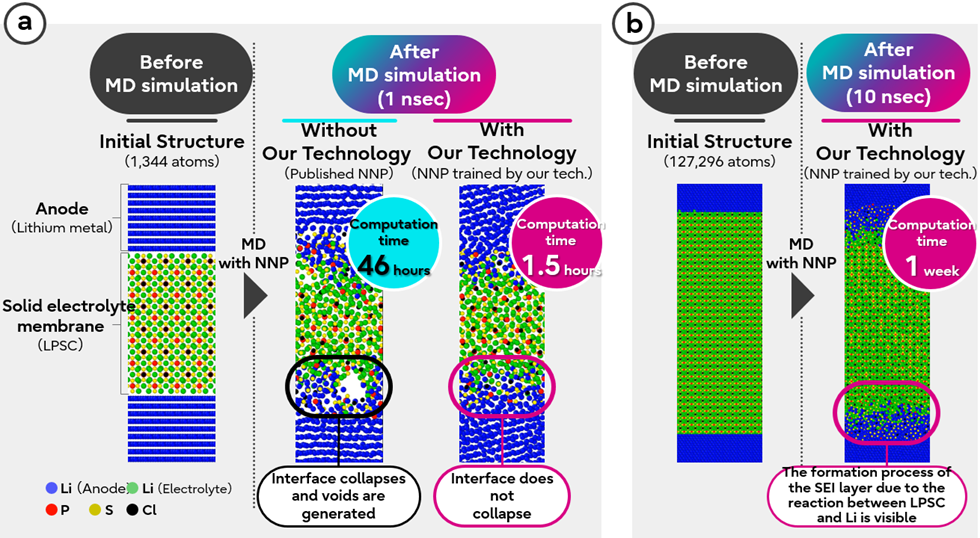
Figure 2: NNP-MD simulation results for all-solid-state battery electrolyte membrane and anode interface system; (a) Example with 1,344 atoms: high-speed calculation achieved without interface structure collapse by applying the developed technology; (b) Example with 127,296 atoms: Stable 10-nanosecond MD simulation of over 100,000 atoms realized in one week
Background
NNP-based MD simulations have recently gained traction for rapidly and accurately simulating material properties at the atomic level. Published NNPs, trained on millions of diverse material data points, are increasingly utilized.
However, material structure collapse during simulation has been an ongoing key challenge with published NNP-based MD simulations, especially for complex materials like all-solid-state batteries. Furthermore, many published NNPs, trained on extensive datasets, employ graph neural networks (GNNs) [6]. While expressive, GNNs are computationally slow, taking over a year for long-duration simulations of large-scale systems exceeding 100,000 atoms, rendering them impractical. This new technology attempts to address these challenges.
[1] Solid electrolyte interphase (SEI):
A very thin passive layer formed at the interface between the electrode and solid electrolyte in all-solid-state batteries. It is formed by the initial reaction between the electrode and electrolyte and the deposition of decomposition products during charge-discharge cycles. It requires high lithium-ion conductivity and electronic insulation. It significantly affects the charge-discharge cycle life and safety of batteries.
[2] Neural network potential (NNP):
A model that constructs a function (potential) representing interatomic interactions using a neural network, a type of machine learning. By learning high-precision calculation results from first-principles calculations (e.g., DFT), it can calculate atomic energies and forces for large atomic systems with accuracy close to first-principles calculations, but at a much higher speed.
[3] Knowledge distillation:
A model training technique in machine learning. It transfers knowledge from a large, complex model (teacher model) to a more compact and faster model (student model). By learning the output (soft targets) of the teacher model, the student model can improve computational efficiency while maintaining the teacher model's performance.
[4] Interface structure:
In physics and chemistry, this refers to the arrangement of atoms and molecules, electronic states, and interactions in the boundary region where two different phases (e.g., solid and solid, liquid and solid) meet. In batteries, it refers to the microscopic structure of the region where the electrode and electrolyte are in contact.
[5] Graph neural network (GNN):
A neural network that directly processes graph-structured data (composed of nodes and edges). It learns node features and edge relationships, demonstrating high expressiveness in analyzing data with graph structures, such as materials and molecules.
[6] Multi-layer perceptron (MLP):
One of the most basic neural network structures. It consists of an input layer, hidden layers, and an output layer, where each layer combines the outputs of the previous layer and propagates them to the next.
Fujitsu's Commitment to the Sustainable Development Goals (SDGs)
The Sustainable Development Goals (SDGs) adopted by the United Nations in 2015 represent a set of common goals to be achieved worldwide by 2030.Fujitsu’s purpose - "to make the world more sustainable by building trust in society through innovation" - is a promise to contribute to the vision of a better future empowered by the SDGs.
About Fujitsu
Fujitsu's purpose is to make the world more sustainable by building trust in society through innovation. As the digital transformation partner of choice for customers around the globe, our 113,000 employees work to resolve some of the greatest challenges facing humanity. Our range of services and solutions draw on five key technologies: AI, Computing, Networks, Data & Security, and Converging Technologies, which we bring together to deliver sustainability transformation. Fujitsu Limited (TSE:6702) reported consolidated revenues of 3.6 trillion yen (US$23 billion) for the fiscal year ended March 31, 2025 and remains the top digital services company in Japan by market share. Find out more: global.fujitsu
Press Contacts
Fujitsu Limited
Public and Investor Relations Division
Inquiries
Topic: Press release summary
Source: Fujitsu Ltd
Sectors: Materials & Nanotech, Artificial Intel [AI], EVs, Transportation
http://www.acnnewswire.com
From the Asia Corporate News Network
Copyright © 2025 ACN Newswire. All rights reserved. A division of Asia Corporate News Network.
|