Kawasaki, Osaka, Japan, Mar 25, 2026 - (JCN Newswire) - Fujitsu Limited and the Center for Quantum Information and Quantum Biology at The University of Osaka today announced the development of a new technology designed to accelerate the industrial application of quantum computers in the era of early fault-tolerant quantum computing (early-FTQC). By combining ver. 3 of the STAR architecture, a unique highly efficient phase rotation gate quantum computing architecture, with a novel molecular model optimization technique, researchers have significantly reduced computational resource requirements. This breakthrough will enable the energy calculations for chemical material design such as catalyst molecules, within a realistic timeframe using early-FTQC quantum computers. These kinds of calculations are currently not possible using current computers, and would take millennia even using previous versions of the STAR architecture. The technologies are expected to contribute to solving various societal challenges, including accelerating drug discovery, improving the efficiency of ammonia synthesis processes, and advancing carbon recycling technologies.
Background
Quantum computing holds significant promise across a wide range of industries, including drug discovery, cryptography, and finance. However, current quantum systems are highly error-prone, and practical applications are generally believed to require quantum computers with millions of qubits.
To improve error correction and accelerate practical application of quantum computing, Fujitsu and The University of Osaka established the STAR architecture ver. 1 on March 23, 2023, followed by ver. 2 on August 28, 2024. The latter, with advanced phase rotation gates, significantly expanded computational scale, enabling potential early-FTQC calculations of solid-state material properties like high-temperature superconductivity.
However, accurately calculating complex molecular chemical energies for practical applications still required excessive resources, and prior methods were limited by insufficient computational power or impractical timeframes.
Newly developed technology
This joint research [1] has demonstrated that combining the following two technologies enables energy calculations for chemical materials with sufficient accuracy and within a practical timeframe:
1. Development of the STAR architecture ver. 3
- STAR architecture ver. 1 and 2 previously demonstrated more efficient quantum computing with unique phase rotation gates over conventional T-gate FTQC architectures
- Ver. 3 improves computational accuracy by more than 10x compared to ver. 2 by integrating phase rotation gates with logical-T gates
- This advancement enables more complex molecular calculations with the same qubit count and lowers the error rate requirements for qubits
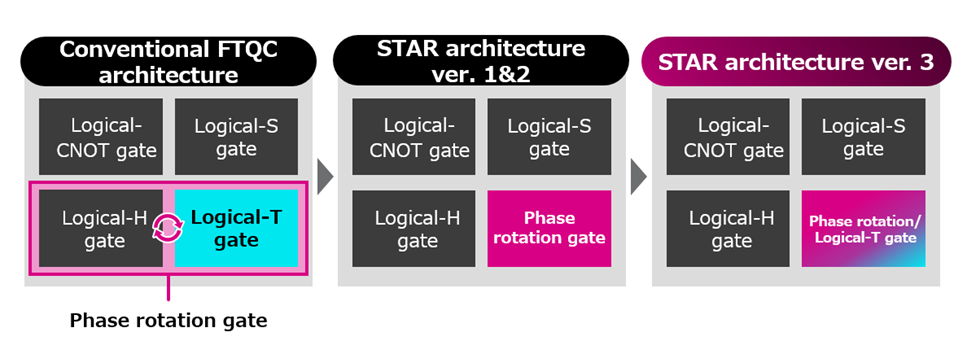
Figure 1: Comparison of universal gate sets in quantum computing architectures
2. Technology for molecular model optimization
- This molecular model optimization technology is designed for use with quantum computers implementing STAR architecture ver. 3 and is applied during the process of generating quantum circuits from molecular models
- This technology refines existing methods, which reduce computational resources by decomposing molecular models into many terms and selectively applying two techniques—time evolution and random sampling—with different characteristics based on the importance of each term
- The technique reshapes the molecular model while preserving approximation accuracy, redistributes term importance, and optimizes the balance between the two techniques. This minimizes the number of gates in quantum circuits for molecular energy calculations, achieving a substantial reduction of computation time compared to conventional methods
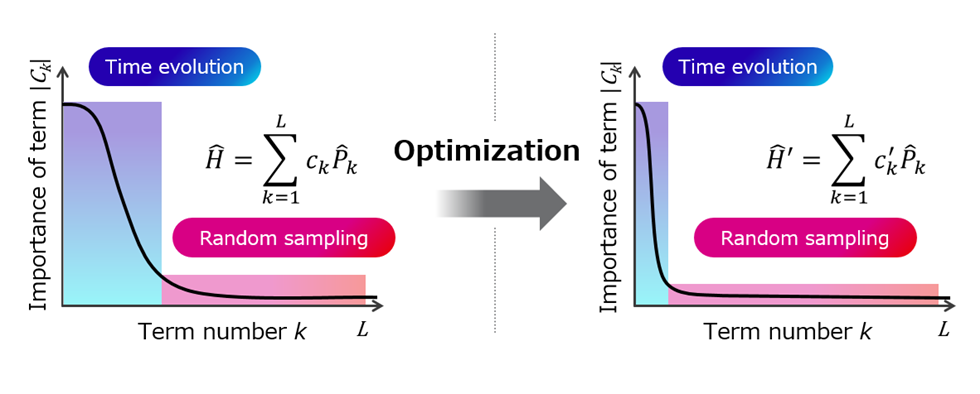
Figure 2: Principle of molecular model optimization
To validate the effectiveness of these technologies, the researchers evaluated the number of qubits and computational time required for industrially applicable energy calculations for three distinct molecules: Cytochrome P450, an important oxidizing enzyme in drug discovery; Iron-sulfur clusters, catalytic proteins involved in ammonia synthesis and energy metabolism; and Ruthenium catalysts, a focus in synthetic chemistry. Accurate energy calculations for these molecules are currently infeasible with classical computers due to memory limitations. Even with the STAR architecture ver. 2, such computations would take several millennia and high precision calculations would be difficult to achieve due to the scale of the calculation. The results of this validation primarily demonstrate that the STAR architecture ver. 3 reduces the number of qubits necessary to perform the calculations to between 1/15 and 1/80 of conventional FTQC architectures. Furthermore, the partners confirmed that calculations are feasible on early-FTQC quantum computers even with a lowered physical error rate requirement for qubits, from the previous 0.01% to 0.10%.
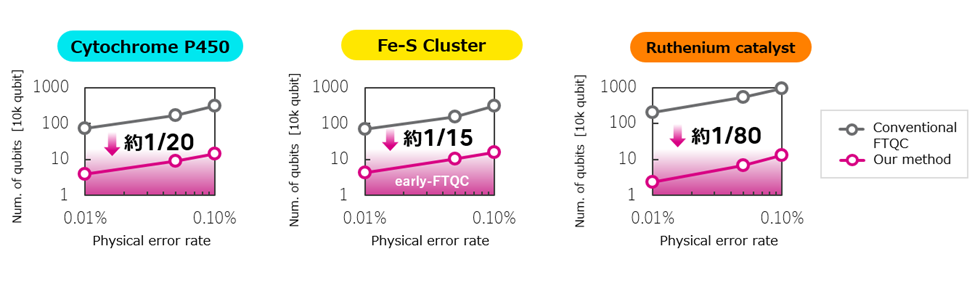
Figure 3: Number of qubits required for energy calculation of three molecules
Moreover, the molecular model optimization technology shortened computation time by three orders of magnitude compared to not using the technology. Fujitsu and The University of Osaka confirmed that computation times could be significantly reduced to approximately 35 days with a qubit error rate of 0.10% and approximately 10 days with 0.01%. Further reduction in computation time is possible with future expected reductions in the physical error rates of quantum computers and the use of parallel computing with multiple quantum computers, making the achieved computation times sufficiently practical.
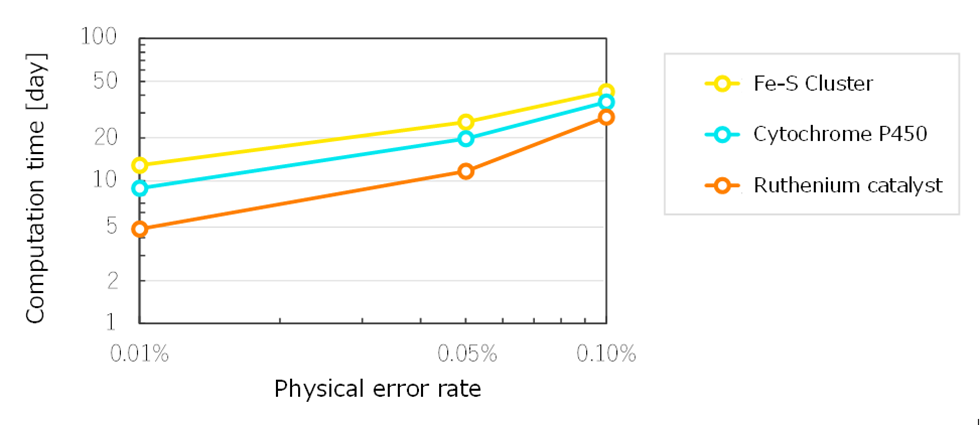
Figure 4: Computational time required for energy calculation of three molecules
Future plans
Fujitsu and The University of Osaka will continue to advance the STAR architecture and molecular model optimization technology, expanding the practical application range of quantum computers in the early-FTQC era. The partners aim to contribute to solving societal challenges by applying these technologies across various industrial fields, including drug discovery, new material development, and finance.
(1) This research was supported by the Japan Science and Technology Agency (JST), the Program on Open Innovation Platforms for Industry-academia Co-creation (COI-NEXT), "Quantum Software Research Hub" (JPMJPF2014); JST Moonshot Goal 6 "Realization of a fault-tolerant universal quantum computer that will revolutionize economy, industry, and security by 2050," R&D project "Research and Development of Theory and Software for Fault-tolerant Quantum Computers" (JPMJMS2061); MEXT Quantum Leap Flagship Program (MEXT Q-LEAP), and "Development of quantum software by intelligent quantum system design and its applications" (JPMXS0120319794)
Related Links
* As of April 2025, the official English name for Osaka University is "The University of Osaka."
Press Conference Materials
Held on March 25, 2026
Presentation Material: Fujitsu and The University of Osaka develop new technologies for chemical material energy calculations on early-FTQC quantum computers
About Fujitsu
Fujitsu’s purpose is to make the world more sustainable by building trust in society through innovation. As the digital transformation partner of choice for customers around the globe, our 113,000 employees work to resolve some of the greatest challenges facing humanity. Our range of services and solutions draw on five key technologies: AI, Computing, Networks, Data & Security, and Converging Technologies, which we bring together to deliver sustainability transformation. Fujitsu Limited (TSE:6702) reported consolidated revenues of 3.6 trillion yen (US$23 billion) for the fiscal year ended March 31, 2025 and remains the top digital services company in Japan by market share. Find out more: global.fujitsu
About The University of Osaka
The University of Osaka was founded in 1931 as one of the seven imperial universities of Japan and is now one of Japan's leading comprehensive universities with a broad disciplinary spectrum. This strength is coupled with a singular drive for innovation that extends throughout the scientific process, from fundamental research to the creation of applied technology with positive economic impacts. Its commitment to innovation has been recognized in Japan and around the world. Now, The University of Osaka is leveraging its role as a Designated National University Corporation selected by the Ministry of Education, Culture, Sports, Science and Technology to contribute to innovation for human welfare, sustainable development of society, and social transformation. Website:https://resou.osaka-u.ac.jp/en
Press Contacts
Fujitsu Limited
Public and Investor Relations Division
Inquiries
The University of Osaka
Center for Quantum Information and Quantum Biology, Planning Office
— Press Release Contact
E-mail: press_qiqb@ml.office.osaka-u.ac.jp
Topic: Press release summary
Source: Fujitsu Ltd
Sectors: Enterprise IT
http://www.acnnewswire.com
From the Asia Corporate News Network
Copyright © 2026 ACN Newswire. All rights reserved. A division of Asia Corporate News Network.
|