TOKYO, July 13, 2026 - (JCN Newswire) - Mitsubishi Heavy Industries, Ltd. (MHI) has demonstrated measurable improvement in Power Usage Effectiveness (PUE)(1) at an operational data center, reducing cooling energy consumption while maintaining stable operation. The project was conducted at the Fujitsu AKASHI Data Center operated by Fujitsu Limited, using existing multi—vendor infrastructure (a mix of equipment from multiple manufacturers).
While traditional optimization focuses on individual equipment, this demonstration applied holistic control across the entire cooling system, including shared cooling infrastructure(2) and air handling units (AHUs) in server rooms. This system—level approach unlocks new energy savings potential and provides a scalable pathway to improve efficiency in existing data centers.
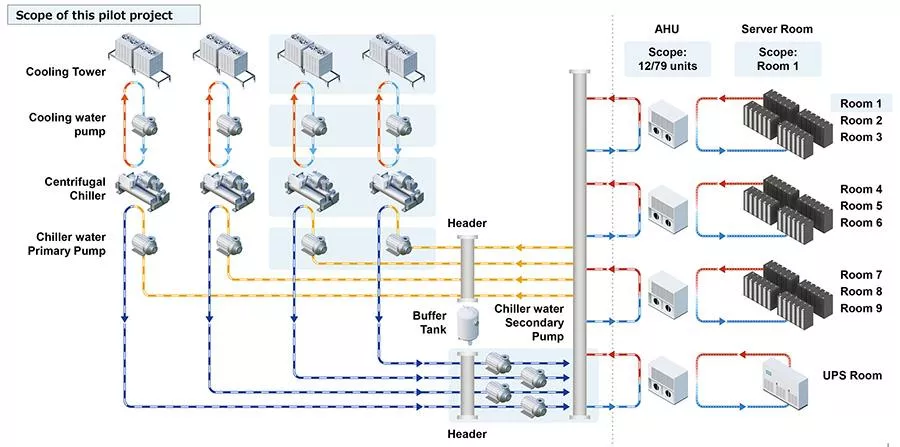
Data center cooling system (Fujitsu AKASHI Data Center)(3)
Addressing a Critical Industry Challenge
With global data center demand surging, energy consumption has become a key constraint. Cooling systems alone account for over 60% of non—IT electricity use(4). Existing facilities prioritize operational stability when controlling cooling systems, making it difficult to incorporate energy optimization as a parallel priority. Further, the increase in AI workloads (the heavy computational processes required to run AI) has made operational requirements more demanding, limiting the effectiveness of existing energy—saving methods, especially those with multi—vendor setups.
Demonstration Highlights and Results
A key differentiator of this project was deployment without service interruption. Leveraging vendor agnostic cooling system optimization technology developed by MHI's Research & Innovation Center, MHI conducted simulations and demonstrated optimized control.
Temperature distribution in the server room was identified as a key bottleneck, and rebalancing of airflow by managing air conditioning units improves the temperature distribution by 2℃ in return providing substantial headroom for optimizing other cooling systems. By fine—tuning the operation points of shared cooling infrastructure based on simulations and maintaining cooling water at an appropriate temperature, the project delivered a 2.3% energy reduction across the entire cooling system. In addition, the energy efficiency (COP)(5) of the centrifugal chillers increased by more than 1.2 points.
This demonstration project was conducted in just one of the several server rooms in the data center. When the scope is scaled across all the server rooms, cooling system energy savings are projected to reach 7.6%, significantly enhancing overall PUE.
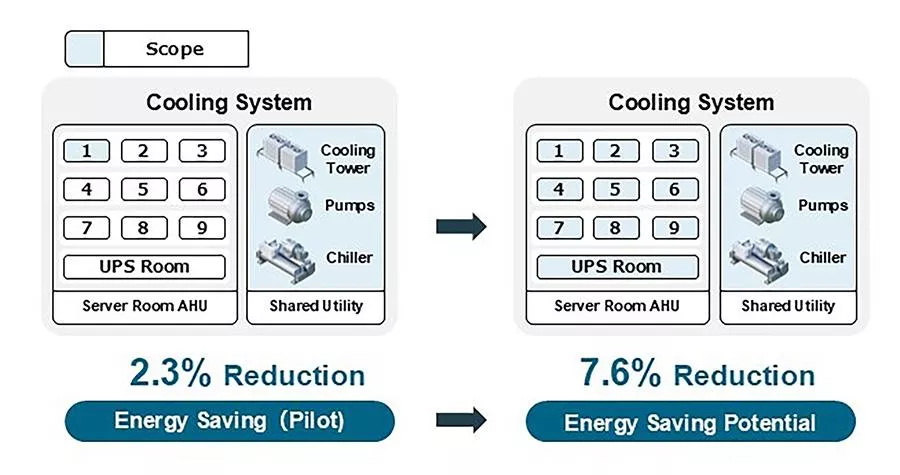
Demonstration results and future potential
"Operational data centers need to improve energy efficiency while utilizing existing equipment," said Shoji Yamasaki, General Manager, Data Center & Energy Management Department at MHI. "This demonstration proves that system—level cooling optimization—especially in multi—vendor environments—can deliver tangible results under real operating conditions."
Going forward, MHI will further expand this approach, integrating decarbonized energy, resilient power systems, high—efficiency cooling, and advanced digital solutions to support sustainable and reliable data center operations worldwide.
(1) Power Usage Effectiveness (PUE) is an indicator of how efficiently a data center uses power. The closer to 1.0, the greater the efficiency.
(2) Shared Cooling infrastructure comprises equipment for cooling the entire data center, including cooling towers, cooling water pumps, chilled water pumps, and centrifugal chillers.
(3) The "header" in the diagram is the main piping system that consolidates and distributes multiple systems of chilled and cooling water, enhancing stable supply and controllability. The "buffer tank" temporarily stores chilled or cooling water, absorbing fluctuations in flow rate and pressure to support stable operation of equipment. A UPS (Uninterruptible Power Supply) ensures a continuous supply of power in case of outages or under abnormal power conditions.
(4) Figures from the International Energy Agency (IEA). For details, see the IEA website.
https://www.iea.org/data-and-statistics/charts/share-of-electricity-consumption-by-data-centre-and-equipment-type-2024
(5) Coefficient of Performance (COP) is an indicator of energy efficiency (effectiveness of cooling or heating relative to the input electricity). Higher the value, greater the energy efficiency.
About MHI Group
Mitsubishi Heavy Industries (MHI) Group is one of the world’s leading industrial groups, spanning energy, smart infrastructure, industrial machinery, aerospace and defense. MHI Group combines cutting-edge technology with deep experience to deliver innovative, integrated solutions that help to realize a carbon neutral world, improve the quality of life and ensure a safer world. For more information, please visit www.mhi.com or follow our insights and stories on spectra.mhi.com.
Topic: Press release summary
Source: Mitsubishi Heavy Industries (MHI)
Sectors: Environment, ESG, Digitalization, Datacenter & Cloud
http://www.acnnewswire.com
From the Asia Corporate News Network
Copyright © 2026 ACN Newswire. All rights reserved. A division of Asia Corporate News Network.
|